
How People Learn From Podcasts: Advantages, Disadvantages, and What Audio Can (and Can’t) Teach
Table of Contents
Of the 4.5 million podcasts currently in existence, there are no statistics telling us how many of these you can learn from.
I suppose, technically, you can learn something from every podcast out there. But the point is that there are no stats on the number of podcasts that are categorised as purely educational podcasts.
When we talk about learning, you likely think of classrooms, textbooks, and online courses. What you’re less likely to think about is how you can learn from podcasts.
But podcasts are an amazing medium to learn through.
They’re free, (largely) free to listen to, easy to access…
But this then raises the question of whether listeners can meaningfully learn from podcasts, bearing in mind that most people listen to podcast episodes passively and whilst they are doing something else, such as driving, commuting or going for a walk.
Before we jump into looking at how people learn from podcasts, let’s look at some stats relating to educational podcasts:
- Educational podcasts take up 7% of all podcast listening time
- In the USA, educational podcasts rank as the 7th most popular genre of podcasts
- In the UK, educational podcasts don’t rank in the top 10 podcasting genres at all
- Educational podcasts tend to be listened to by younger audiences
- Educational podcasts are less likely to be a ‘successful show.’ Successful shows are more likely to be in comedy, news, and true crime categories
- Research doesn’t necessarily demonstrate that listening to educational podcasts increases test scores
What this tells us is that whilst educational podcasts might not be the top of everyone’s playlists, there is a space for them with listeners.
The challenge, then, isn’t whether educational podcasts can exist, but:
- How effective they are
- What they’re best suited for
- What both podcasters and listeners need to understand about learning through this medium

Can You Really Learn From Podcasts?
Of course you can!
In the same way that you can learn from online courses, blended learning approaches, YouTube videos, digital downloads, books, and being in a classroom, you can, of course, learn from podcasts.
Related Post >> How to Start an Educational Podcast (That Actually Helps People Learn)
Who Teaches via Podcasts?
Educational podcasts are now hosted by a whole range of people and organisations, including:
- Schools
- Colleges
- Universities
- Training organisations
- Employers
- Youth groups
- Bloggers
- Entrepreneurs
- Hobbyists
- Charities
- Governments
There’s no one group of people to whom teaching and educating via a podcast is exclusive to.
And that’s the really exciting thing about it. Anyone can have a go at creating an educational podcast and offering their expertise to others to learn from.
4 Types of Educational Podcasts
There is no single ‘type’ of educational podcast, but you’ll usually find that an educational podcast will fit into one of the following types, or a combination of one of more.
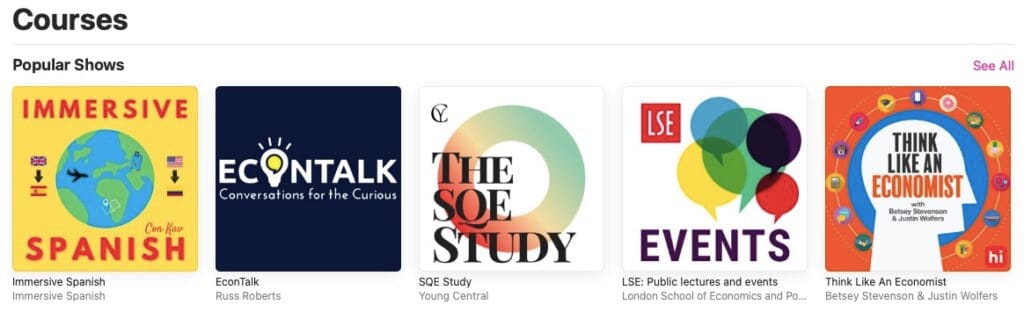
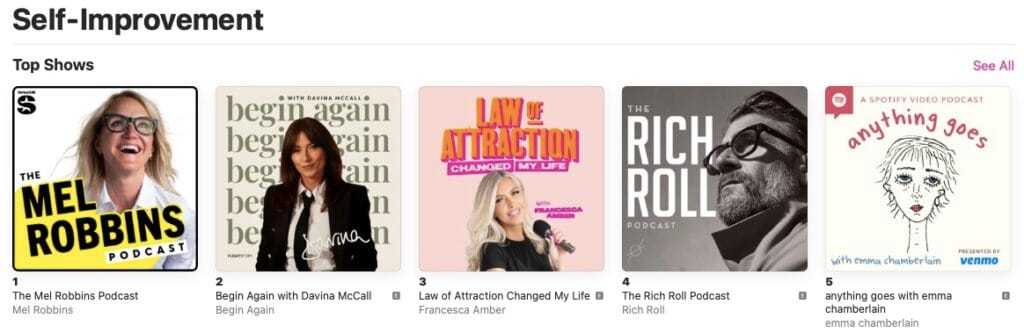
Within Apple Podcast are 4 sub-categories for educational podcasts: courses, how to, language learning, and self-improvement.
1. Courses
The first type of educational podcast is courses.
These podcasts often follow a curriculum, can have a long run, or be kept to a succinct few episodes. They could be hosted by a range of organisations or indie podcasters and can have the goal to teach something very specific or very broad.
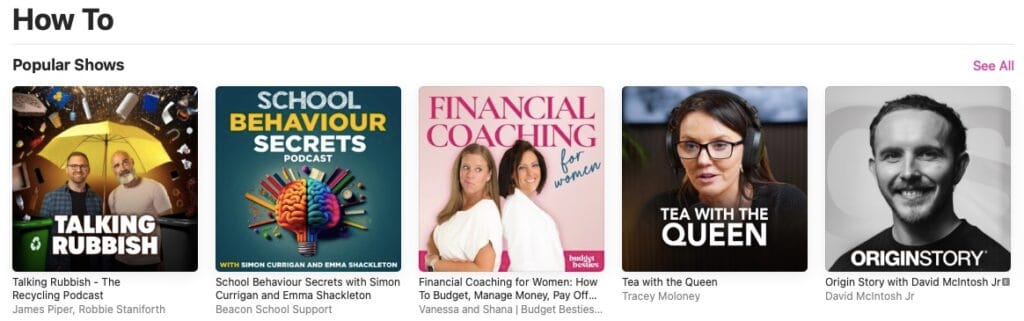
2. How To
This is where Podcasting for Indie Podcasters sits!
Podcasts in this category can include a range of topics and include case studies or real-life experiences. They may teach you with explicit instructions or help you learn through reflections.
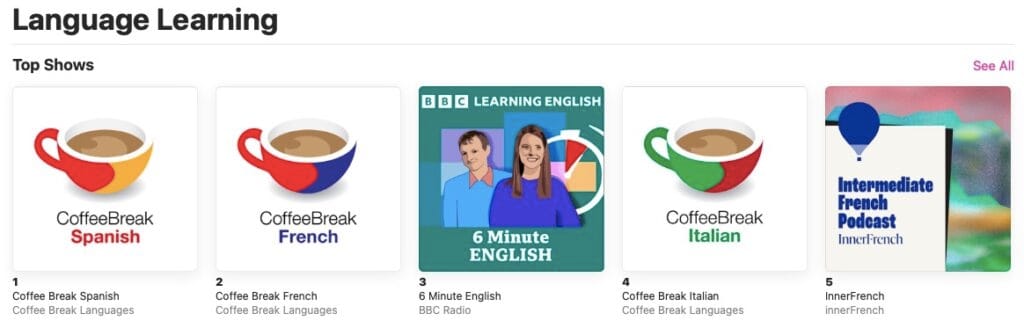
3. Language Learning
This is pretty self-explanatory, I feel. These podcasts teach you to learn a language in some way, shape or form.
4. Self-Improvement
These podcasts aim to teach listeners how to do something, such as improve a skill, adopt a practice, or change a behaviour.
They work best when the skill being taught does not rely heavily on visual demonstration and could be supported by additional resources such as transcripts, checklists, or videos.
What These Sub-Categories All Have in Common
Despite their different names, what each of the sub-categories has in common is that there is no right or wrong way to present your educational podcast.
Within each of these categories are podcasts that are:
- Hosted by universities, subject specialise, and indie podcasters
- Interview-led, have solo episodes, or a mixture of both
- Hosted by one or multiple people
- Use stories, case-studies, and real-life examples, facts and fiction to help the listener to learn
Related Post >> How do I Get My Podcast on Apple Podcasts?
Can Podcasts Be Used As Part of Traditional Teaching Methods?
Podcasts 100% can and are used as part of traditional teaching methods. There are a whole load of podcasts that are aimed at people across various parts of the education system to help develop their knowledge on a range of topics.
Some educational establishments are now even using podcasts as an assessment method and having students create a podcast as a way to evaluate their learning. (Although I have to say, I do wonder what this then does to the stats around podcasts that went into podfade and active versus inactive podcasts, but I digress.)
Podcasts can be used to complement traditional teaching methods by:
- Introducing a topic before a lesson, for example, as a pre-learning tool or for a flipped classroom model
- Reinforcing key ideas after a lesson
- Providing alternative thoughts on a topic for students who want to expand their knowledge further
- Reinforcing the key points of a lesson for students who might need some repetition
- Supporting revision
In this context, though, teachers need to be clear that the podcast is complementing traditional teaching and not replacing it.
And this is a key difference between when podcasts are used as part of a larger teaching model and podcasters who provide an educational podcast that doesn’t sit with formal assessment and curriculum.
Despite being a flexible way to learn, students need to be aware that they cannot get everything they need to know from a podcast and will still need to engage with the other learning resources that they are provided with.
9 Advantages of Learning and Teaching Through Podcasts
Learning through podcasts has so many advantages that the following list really could be endless.
However, I’ve narrowed it down to the top 9 advantages that demonstrate how learning through podcasts is beneficial to both you as the podcaster and your listeners.
In brief, the advantages of learning through podcasts are:
- Increased flexibility
- Ease of access
- Cost savings (for your listener)
- Your own costs are very low
- Promoting self-paced learning
- Supporting learning adaptations
- Providing up-to-date content
- Podcasters having access to data and analytics
- Podcasts are great for mindset shifts
1. Increased Flexibility
When someone chooses to learn through a podcast, it means that they can engage with that learning at any time that best suits them. Most commonly, this will be when they are doing something else, for example driving, cooking the dinner, etc.
Whilst this means that listeners’ learning could end up being quite passive (because you can only learn so much when you’re multi-tasking), it does mean that listeners can be increasingly flexible with when and where they are tuning into an educational podcast to learn.
2. Ease of Access
In 2026, podcasts are so easy to access, and unless your content sits behind a paywall, the very vast majority of podcasts are also available for free.
This means that your audience no longer need to work out childcare options, their availability, etc, when it comes to accessing information.
At one point, to find out about a certain time period in history, you might have needed to engage with a course at a local college or go to the library to check a book out.
Now, the same information can be accessed by a few clicks on a listener’s laptop, computer, or phone.
3. Cost Savings
We already touched on this briefly in the point above, but because of the very nature of podcasts, it’s incredible how much information delivered by experts is absolutely free via a podcast.
Yes, to see these experts speak live, you might still need to purchase a ticket. And to get their in-depth content, you might need to pay for a course or book. But by and large, both big names and indie podcasters alike are sharing tonnes of really high-quality information to the world without charging a single penny.
4. Your Own Costs Are Very Low
One of the biggest advantages of educational podcasts is that they are low-cost to run. Unlike a traditional classroom or one-on-one tutoring, educational podcasts don’t require you to hire any building space, pay for facilities, hire equipment, etc.
You just need a microphone, some recording and editing software, and a podcast hosting platform.
Related Post >> Podcasting on a Budget: How I Slashed My Podcasting Costs by 65%
5. Educational Podcasts Promote Self-Paced Learning
One of the biggest advantages of learning through a podcast is that your listener can learn at their own pace.
If they want to binge 4 episodes in one go, they can.
If they want to listen to one episode a week only, they can.
They can re-listen to episodes, or parts of episodes that they were most interested in and skip over anything that isn’t relevant (and this is massively helped by ensuring that your episodes are transcribed and have chapter markings to help listeners listen to the parts that they most want to listen to).
6. Podcasts Can Support Learning Adaptations
Let’s face it, no two people learn the same. We’re all individual and with that individuality, we all have different learning styles and needs.
Podcasts enable people to listen how they want, either on loud speaker, or with headphones on. Your audience might also prefer to engage with your transcript, either following the transcript as the episode plays, or checking the transcript for clarification on a topic.
In this way, including transcripts with your podcast episodes can be really supportive for listeners who don’t speak the language you’re presenting in as a first language and those with hearing difficulties.
7. Up-to-Date Content
When books are written, it can take months if not years to get them to the publication stage. (And yes, I know we live in a world of AI where books can be written and published within hours, but I like to think that people are getting wise to a lot of the AI-generated garbage that is popping up. Also, a lot of educational texts are still published via traditional publishing methods.)
Podcasts are completely different.
You can have an idea for an episode, research it and then have that episode published within a matter of hours, days, or weeks, depending on your publishing schedule.
And this means that listeners are getting current content.
8. Data and Analytics
Unlike traditional classroom teaching, educational podcasts can give you an insight into how your listeners interact with your podcast.
Thanks podcasting analytics!
Through your analytics, you can see:
- How many people are downloading your podcast
- How far into your episodes they’re listening
- If there are certain topics that seem to be piquing your audiences interest more than others
- How many unique listeners you have
- How many people are returning to your show
- Your listeners’ demographics in terms of gender, age, location
Being aware of this data and analytics enables you to adapt your podcast episodes based on what you’re being shown in the analytics. And optimising your content based on analytics ensures that you are delivering a podcast that is best suited to your audience.
For example, if you’re finding that a lot of people aren’t completing your episodes, you might need to split the episodes down into more manageable episodes where you cover less content per episode.
Related Post >> Why Unique Listeners for Your Podcast Are More Important Than You Think
9. Podcasts are Great for Mindset Shifts
We’ve already talked about how some things just can’t be taught or learned through podcasting, but one of the biggest things that audiences can learn from podcasts is mindset shifts.
So many podcasts offer hosts and their guests the opportunity to get real with their audience and deliver raw stories and experiences that listeners can learn from.
And these conversations, be they from solo episodes or guest interviews, can really change and shape how a listener views a topic or how they understand how something works.

7 Disadvantages of Learning and Teaching Through Podcasts
Now that we’ve gone over the advantages of having people learn from podcasts, we do need to be realistic and realise that it’s not all sunshine and flowers: there are disadvantages to learning from a podcast as well.
And these disadvantages can affect you as the podcaster, just as much as they could affect how your listener learns from your podcast.
Some of the main disadvantages of learning through podcasts are:
- Digital poverty
- Learning new software
- Educational podcasts require marketing
- You only have a short window to validate yourself
- Not everything can be taught through a podcast
1. Digital Poverty
Digital poverty is a phrase that has become more prominent during the COVID pandemic, but if you’re creating an educational podcast, then digital poverty can be a very real issue for both you and your listener.
If you’ve not heard of digital poverty before, it can be broken down into two parts:
- Those who cannot afford the equipment to access digital services. For example, internet services, smartphones, tablets, computers etc.
- Those who do not have the digital skills and know-how to access digital services. This group of people may have the money and resources to have the digital equipment required to access digital services, but for one reason or another lack the information and know-how to properly use this equipment.
And this can cause a few issues. For example:
- You could want to start an educational podcast but are worried that you don’t have the tech know-how to do so
- Your ideal listener might not know or be able to access your podcast
Your approach to tackling this issue will differ depending on who you are.
If you’re a podcaster and you want to start your own podcast, you could access free resources (hint, hint, wink, wink, this blog and the Podcasting for Indie Podcaster’s Podcast 😉) to up-skill yourself to start your own podcast.
If you already have a podcast or aren’t concerned about your own tech skills, you could provide a guide on your website to explain to people how to access and listen to your podcast.
2. Learning New Software
Carrying on from the lines of the previous point, even if you are quite tech-savvy, there is still a learning curve that comes with setting up and running any type of podcast, let alone an educational podcast.
Learning new software can be daunting, and it may make you stick to ‘safe’ software which you’ve used before or other people recommend.
In these situations, remember that there is tonnes of free information online to support you with starting and running your podcast (again, nudge, nudge, wink, wink!).
And remember that YouTube is your friend.
3. Educational Podcasts Require Marketing
Like anything, your audience who love to learn from podcasts are not going to magically start listening to your show.
You need to find them, and you need to help them to find you.
I’m not going to go big into marketing strategies for this section of the blog, but you do need to work out some sort of marketing strategy for your show. This may include social media, email marketing, physically telling people: whatever works for you and your show.
But ultimately, remember that no one is going to learn anything from your podcast if they don’t know it’s there.
Related Post >> Podcast SEO: Getting Your Show Found by Your Ideal Listener
4. You Can’t Gain Instant Feedback from Your Listeners
Yes, analytics exist, but in the moment that your audience is listening to your show, you can’t see if a listener is starting to look bored, or decides to leave the room and leave your show running for a few minutes.
Because people listen to podcasts without you around, you’re not getting the same in-the-moment feedback you might get if you were teaching people face-to-face either online or in a classroom.
The only way you can really get feedback from listeners is through:
- Your analytics
- Podcast reviews (so ask your listeners to leave them!!)
- Listeners contacting you telling you what they thought of an episode (so make your contact details, i.e. a contact form or social media handles available for people to contact you)
Related Post >> Important Podcast Metrics: 10+ Numbers Podcast Hosts Need to Analyse
5. You Only Have a Short Window to Validate Yourself
Let’s say you host a business podcast and you’re teaching your audience how to grow their company to get £1m in revenue within the next 5 years.
Within the introduction of your episodes, you need to validate yourself to your audience very quickly that you’re the right person to deliver this information, otherwise, your listener will wonder how they can trust you and what you’re telling them.
People learn best from those whom they trust. And this trust could be based on experience, on qualifications, on so many things.
But if you want your listener to learn from your podcast, then you need them to be able to trust you to educate them. Otherwise, they’ll find someone else who they feel is qualified to teach them.
And no, I don’t mean qualified as in they have a certificate saying they’re qualified in something. Qualification can come from lived experience, an interest, or extensive research on a subject as well. I have no formal qualifications in podcasting. What I do have is experience in hosting and producing podcasts since 2022, an interest in podcast production, and a desire to learn more about podcasting.
Building listener trust in you so that they can validate you as the person to learn from can mean that you drop information in your introduction that helps them see that you’re the ideal person to host your podcast. This could be mentioning a qualification or your passion in the subject you podcast on.
Related Post >> How to Create a Podcast Intro
6. Not Everything Can Be Taught Through a Podcast
And because not everything can be taught through a podcast, not everything can be learned through a podcast either.
It might sound silly, but you need to remember that not everything can be taught through audio.
And I’m not getting into the ‘podcasts need video to survive’ debate. We all know where I stand on that one and it’s firmly in the ‘you don’t need video for your podcast’ camp.
But if you are running an audio-only show, or even if you do provide video but have the option to listen audio-only, you need to be realistic that not everything can be learned via audio only.
Some skills do need a visual. Some skills need to physically be physically practised under supervision. Some skills differ depending on the situation.
Take planting a garden, for example.
On your podcast, you could discuss when to plant seeds, including the right time of year, depth of soil, soil conditions, etc. But someone who has never planted seeds before might have a hard time following audio-only instructions.
To get around this, it’s firstly really important for you as the podcaster to know the limitations of the topic that you’re teaching via your podcast.
Consider how you learnt the information yourself. Did you learn it through a podcast or by reading, or were you shown it?
It might sound a little blunt, but if you need to show in order to teach something to your listener, then you will either need to:
- Be incredibly descriptive so they can imagine what you’re explaining
- Provide a video or downloadable print-out guide to go with the episode
- Allow listeners a way to contact you and ask questions for follow-up
The worst-case scenario is if you’re trying to teach something to someone audio-only that just doesn’t fit that way, you’re going to end up with listeners who leave your audience because they can’t effectively learn what they want from your show.
7. Some Listeners Might Need Support After Your Episode
Depending on what was covered in your episode, some listeners might require some signposting for follow up support.
Perhaps you were delivering an episode about building a business and your guest talked about their journey from being homeless to now earning 6 figures.
Whilst this is very inspriational to hear, some people may feel triggered hearing about the experience of being homeless. Perhaps they have been homeless themselves or know someone who is, for example.
It can be hard to have trigger warnings for every topic you might cover on your show, but if you do think that someone might be triggered by a discussion on your show, you might want to remind them to reach out to the relevant organisations who can help, or even provide links in your show notes to websites with further information.
Related Post >> How to Introduce Podcast Guests & Keep Your Audience Engaged
Final Thoughts on How People Learn from Podcasts
Learning from podcasts is a great way to be educated, inspires, challenge your thoughts and deepen your understanding on so many subjects.
Equally, as a podcaster, it’s incredible knowing that you are contributing to someone’s knowledge on a topic.
Podcasts are brilliant as learning tools in terms of flexibility, accessibility, cost and currency of information. But with this, we need to remember that not everything can be taught through audio alone.
If you’re creating and hosting an educational podcast, then you need to understand how your listeners best learn from podcasts in order to tailor your content to that audience.
You can’t teach everyone via your podcast. And that’s ok, you don’t need to. You just need to present the information in your podcast in a way that helps your listeners learn in a way that works for them.

Verity Sangan
Hey! I'm Verity. I love all things podcasting and am passionate about helping more women to find their voice through podcasting. When I'm not working or busy with mum duties, I host Podcasting for Indie Podcasters (formerly The Lazy Girl's Guide to Podcasting).