

How to Do a Podcast Audit in 7 Easy-to-Follow Tasks
Table of Contents
If you’ve had a podcast for any amount of time, you’ve probably wondered to yourself if you’re doing things ‘right,’ or how you can reach more people to boost your audience.
In this case, a podcast audit is probably one of the best activities you can do for your podcast.
Why?
Because auditing your podcast helps you see where your show currently is and helps you to map out where you can make improvements for your show.
In this blog post, we’ll explore the benefits of auditing your podcast, as well as some tips and tricks for doing so effectively.
What is a Podcast Audit?
In short, a podcast audit is a systematic process of examining and reviewing your show to ensure that it meets expected standards or expectations.
In podcasting, auditing your show means looking at a range of areas from a listener’s point of view to figure out how to make improvements and up your podcasting game.
Often, podcast audits can focus on weaknesses and areas for improvement.
But this isn’t all that auditing is. Auditing is also recognising where you’re doing things well and the strengths of your podcast.
During your podcast audit, you may choose to review parts of your podcast such as the:
- Structure and format of your episodes
- Sound quality of your recordings
- Consistency of your release schedule
- Engagement stats of your audience
- Feedback you receive from your listeners
- Your podcast’s SEO
The goal is to gain a clear understanding of what’s working well and what needs improvement, and to develop a plan for implementing changes that will help your podcast grow and thrive.

Why Run a Podcast Audit?
Ok, this is a great question. We’ve already covered the basics of what a podcast audit is, but as a podcaster, why should you audit your own show?
There are 5 main reasons why you should audit your podcast:
1. Give Yourself Some Kudos for How Well You’re Doing
You have created and run your entire show by yourself, most likely with very little input from anyone else.
That’s amazing!
Before you dive into the knitty-gritty of your show and start being too hard on yourself, I want you to spend a few minutes just reviewing what you have achieved to this point.
Sure, maybe your first episodes weren’t as polished as your later ones, but that’s ok. It’s about recognising your growth and development for both your show and you as a podcaster.
2. Identify Areas for Improvement
This is the main reason for auditing your podcast.
Because by auditing your podcast, you can identify areas that need improvement.
This could include the quality of your content, your delivery, your show notes, or the value of your episodes. This can help you make changes that will enhance the listening experience for your audience.
3. Improve Listener Engagement
Through the feedback you gather during a podcast audit, you can gain insight into what your listeners want to hear and how you can better engage them.
By making changes based on this feedback, you can build stronger relationships with your audience and keep them coming back for more.
Why?
Because your audience is seeing that you’re listening to what you’re telling them and responding to the feedback. Of course, it is your podcast at the end of the day, so no, you don’t have to change your podcast to suit every piece of audience feedback.
Listener feedback can be gained from a range of places including:
- Reviews left on podcast directories
- Comments about your episodes on social media
- Emails and DMs from listeners about your show
You can also send out tailored feedback forms to your audience through a mailing list or by asking on social media. This is useful if you want to get answers to some very specific questions, but remember that feedback forms don’t tend to be filled out very well, if at all, unless the person filling out the form can see something in it for themselves.
4. Maintain Your Own Standards
Podcasting is a highly competitive medium, and many other shows are vying for your listeners’ attention.
By auditing your podcast, you can ensure that you are meeting the quality standards that your audience expects and that you are producing content that is worth their time.
It might even be worth looking at the quality of other shows that your audience might be interested in to draw a comparison and see where improvements can be made.
I’m not saying that you suddenly need to invest in more expensive podcasting equipment or tech stack; but when you listen back to your episodes, do you notice that the audio could be improved or do you find that you go off on tangents and it takes you ages to cover what you promised in the episode?
Both of these issues have easy fixes.
Your audio could be improved by making sure you’re using the right settings for your microphone, sitting closer/further away from your microphone, or slightly adjusting your recording set up.
If you find that you go off on tangents, perhaps you need to plan your episodes more carefully and have either a script or bullet points to help you keep on track.
5. Stay Organised and On Track
Auditing your podcast can also help you stay organised and on track with your production schedule.
By reviewing your past episodes and planning for the future, you can ensure that you are delivering content consistently and effectively. When you audit, you don’t have to go through your entire back catalogue. You might choose a few episodes at random, or focus on a particular month or season.
I recently audited both my blog and podcast episodes.
What I found was that I had a tonne of blog posts that had no corresponding podcast episode, episodes that now featured out-of-date content, and episodes that could do with a part 2 or an extension to bring my audience more information on that topic.
Through looking through all of these past episodes and blog posts, I’ve now listed out 8 months’ worth of episode ideas, all from about an hour’s work!

How Often Should You Audit Your Podcast?
Podcast auditing can take place as regularly as you’d like it to. Whenever you make changes to your podcast, it’s always worth running a mini audit a few weeks or months later to see if that change was positive.
However, for a deep-dive audit that covers your whole show, I would recommend trying to do one at least once a year.
How to Audit Your Own Podcast
Set aside some time to audit your podcast, grab your favourite hot drink and get comfy. If you’re comfortable during the audit, you’ll have more fun doing it and see the podcast audit as an enjoyable experience rather than ‘work.’
1. Listen to Your Past Episodes
Start by listening to your past episodes with a critical ear.
You don’t need to listen to every single episode that you’ve ever published; choose a selection at random, or your least listened to episodes. Make sure that you listen to your intro and outro as well as the episode content for a full listener experience.
When I used to do podcast audits commercially, I only ever include 3-4 episodes per audit as this is enough to give me a flavour of a show, without being overwhelmed with the amount of content to review.
Take notes on what worked well and what could be improved. Pay attention to things like the structure and format of your episodes, the sound quality of your recordings, and the delivery of your content.
Related Post >> 4 Tips for Getting the Most Out of Podcast Listening
2. Review Your Analytics
Look at your podcast analytics to get a better understanding of your audience demographics, listening habits, and engagement levels.
Use this data to identify trends and patterns that can help you better target your content to your listeners.
Questions to consider when looking at your podcast’s analytics are:
- Which are you least listened to episodes?
- Which are your most listened to episodes?
- Which are you least and most downloaded episodes?
- Which episodes have the best completion percentage?
- Which platforms are your episodes being listened on?
- Who are your listeners in terms of their gender, age, and location? Is this your target audience?

3. Gather Feedback
Look at the feedback your show has organically gained. As I mentioned earlier, this feedback could be from:
- Reviews left on podcast directories
- Comments about your episodes on social media
- Emails and DMs from listeners about your show
This type of feedback is invaluable as it helps you understand which of your episodes are resonating most with your audience and why.
4. Evaluate Your Branding
Take a critical look at your podcast branding, including your:
- Cover art
- Website
- Episode artwork
- Social media profiles
Is the branding cohesive? Does it convey the premise of your show? For example, does your branding make you feel happy? Inspired? Serious?
Related Post >> 5 Reasons Why You Need To Use The Canva Brand Kit
5. Google Yourself
Well, Google your show rather than yourself exactly.
If you type your show’s name into Google, what results do you get?
Ideally, your show should dominate the first page of Google, especially if it’s on multiple podcasting directories. If it isn’t this could be a sign that you need to consider your SEO strategy.
Next, think of the keywords that people are searching for when they find your show and type those keywords into Apple Podcasts and Spotify (plus any other smaller directories that your analytics tells you that your audience listens to your show on).
What comes up?
If your show comes up high in the search results – brilliant.
If not, this again could signal that you need to work on your podcast’s SEO strategy.
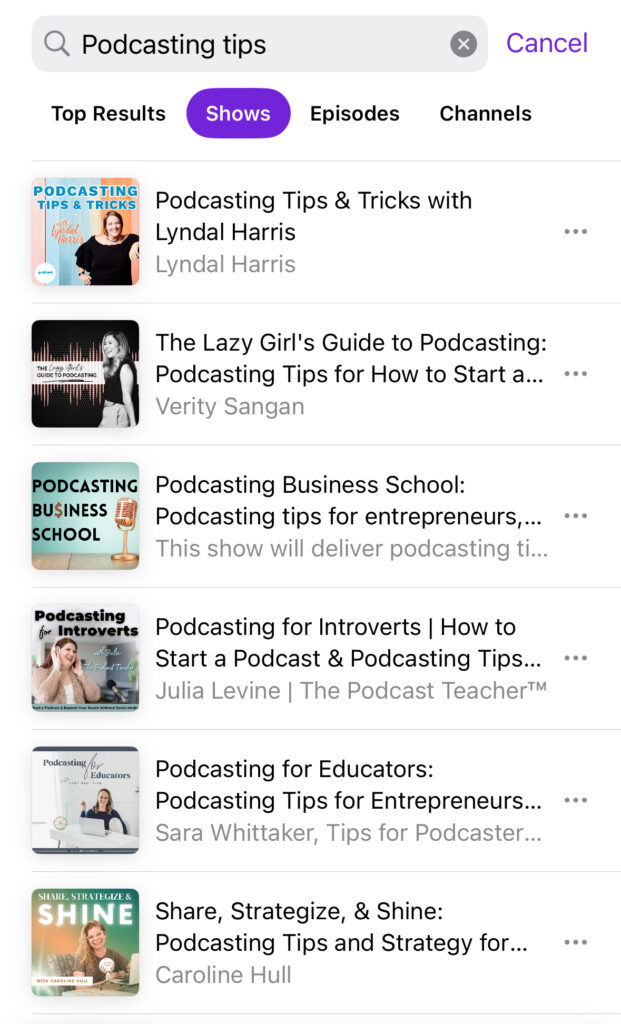
Consider which keywords your audience could be using when searching for a podcast, and experiment with adding these keywords in your episode titles, show notes, podcast title, blog posts, or wherever else suits your SEO strategy to try and get your show in front of new listeners.
Remember, though, what your audience is searching for isn’t always the same as what you think they’re searching for. It’s worth keeping an eye on the keywords you use in your SEO strategy and tweaking them accordingly.
6. Plan For The Future
Use the insights you gain from your podcast audit to develop a plan for the future of your podcast.
This may involve making changes to your content, improving your production quality, or adjusting your SEO strategy.
7. Review Your Podcast Title and Tagline
Naming your podcast can feel like an absolute marathon of a task.
I know; I’ve named and renamed two podcasts at this point.
But if you’re struggling to get listeners, it’s key to look at your title and tagline and see if they can be optimised for search.
Witty and clever podcast titles make us smile, but as an indie podcaster, it can be hard to get your show found by your ideal audience if your podcast’s title and tagline don’t include any keywords at all that link to what your audience is searching for.
Including at least one keyword in your podcast’s title and tagline can dramatically help get your show found by the right listener.
And then once they’ve found your show, having a keyword can help them qualify themselves to listen to your show as well.
For example, if your show has ‘for female entrepreneurs’ in the title, a female entrepreneur can automatically qualify themselves because they know the show is for them (depending on whatever is before that keyword in the title).
Related Post >> How to Name Your Podcast
Final Thoughts on Running a Podcast Audit
Auditing your podcast can take many forms and can range from a quick 5-minute job, to spending hours diving into the weeds of your show.
However, you audit your podcast, a regular review is worthwhile, especially if you aren’t seeing the results that you want to be seeing.
A good podcast audit will:
- Make you feel proud of what you’ve achieved so far
- Identify areas for improvement
- Improve listener engagement
- Help you plan your show for the future

Verity Sangan
Hey! I'm Verity. I love all things podcasting and am passionate about helping more women to find their voice through podcasting. When I'm not working or busy with mum duties, I host Podcasting for Indie Podcasters (formerly The Lazy Girl's Guide to Podcasting).


You May Also Like

Should You Include Episode Numbers in Podcast Episode Titles? We Say Yes and Here’s Why

How to Listen to Podcasts for Learning: 4 Tips to Get More Value