
Should You Leave Your Pauses in Your Podcast Episodes?
Table of Contents
If you spend any time editing your show, you have probably agonised over pauses in your episodes.
Those moments of silence can feel awkward, unprofessional, or like something you should automatically cut out. Podcasting advice often tells us to trim, tighten, and remove every second of dead space. But pauses in your episodes are not always a problem to fix. Sometimes they are doing far more work than we give them credit for.
In this post, we explore why pauses have become such a hot topic in podcasting, when leaving pauses in your podcast episodes can actually improve your show, and when removing them might still be the right call.
Why Pauses in Podcast Episodes are Such a Debated Topic
The debate around pauses in podcast episodes has grown as podcasting technology has evolved.
Editing tools now make it incredibly easy to remove silence with a single click. Platforms like Riverside.fm and Descript actively encourage the removal of pauses with AI features that detect and delete pauses longer than a few seconds (and you can often finetune this for even shorter pauses if you want to).
On the surface, this sounds like progress. Faster edits, tighter episodes, and less effort all round.
There is also a wider cultural influence at play.
We are surrounded by fast paced content.
Social media, YouTube, and short form video reward speed and constant stimulation. Silence is often framed as a failure to hold attention. That mindset has seeped into podcasting, even though podcasts are a very different medium.
Many podcasters are taught early on that pauses are annoying for listeners. We are told people will switch off, skip ahead, or assume something has gone wrong. As a result, silence becomes something to fear rather than something to use intentionally.
But real conversations are not like that.
People do not speak at full speed without stopping. We pause to breathe, to think, to find the right words, or because something emotional has landed. When we strip all of that out, we risk creating something that sounds polished but not human.
That tension between sounding professional and sounding real is at the heart of the debate. Should a podcast aim for efficiency at all costs, or should it reflect how people actually speak and process information?
Related Post >> Descript: The Audio Editing Tool Every Podcaster Needs

Why Leaving Pauses in Your Podcast Episodes Can Be a Good Thing
One of the strongest arguments for leaving pauses in your episodes is that they make your podcast episodes feel more real and like you’re listening to a human talking.
Think about it; when you are listening to someone speak, you are not just processing words. You are picking up on tone, pacing, emotion, and intention. And pauses are part of that communication.
In natural conversation, pauses often signal that something matters. A moment of silence can show reflection, hesitation, or emotional weight. When those pauses are removed, the meaning can subtly change. What was once thoughtful can start to feel rushed. What was emotional can sound oddly flat.
Leaving pauses in becomes especially important in interview-based podcasts. For example, when someone shares something personal, difficult, or deeply considered, a pause can give that moment space to breathe. These pauses allow the listener to sit with what has just been said rather than being immediately pushed on to the next question or topic.
There is also the listener experience to consider.
Pauses give your audience time to digest information. If you jump rapidly from point to point, you are assuming that everyone processes information at the same speed, and that is rarely the case. A short silence can help listeners reflect, connect the dots, or recognise something that resonates with them personally.
When Pauses in Your Podcast Episodes Can Work Really Well
A great example of using effective pauses in podcast episodes comes from interview styles that are rooted in therapy or deep conversation.
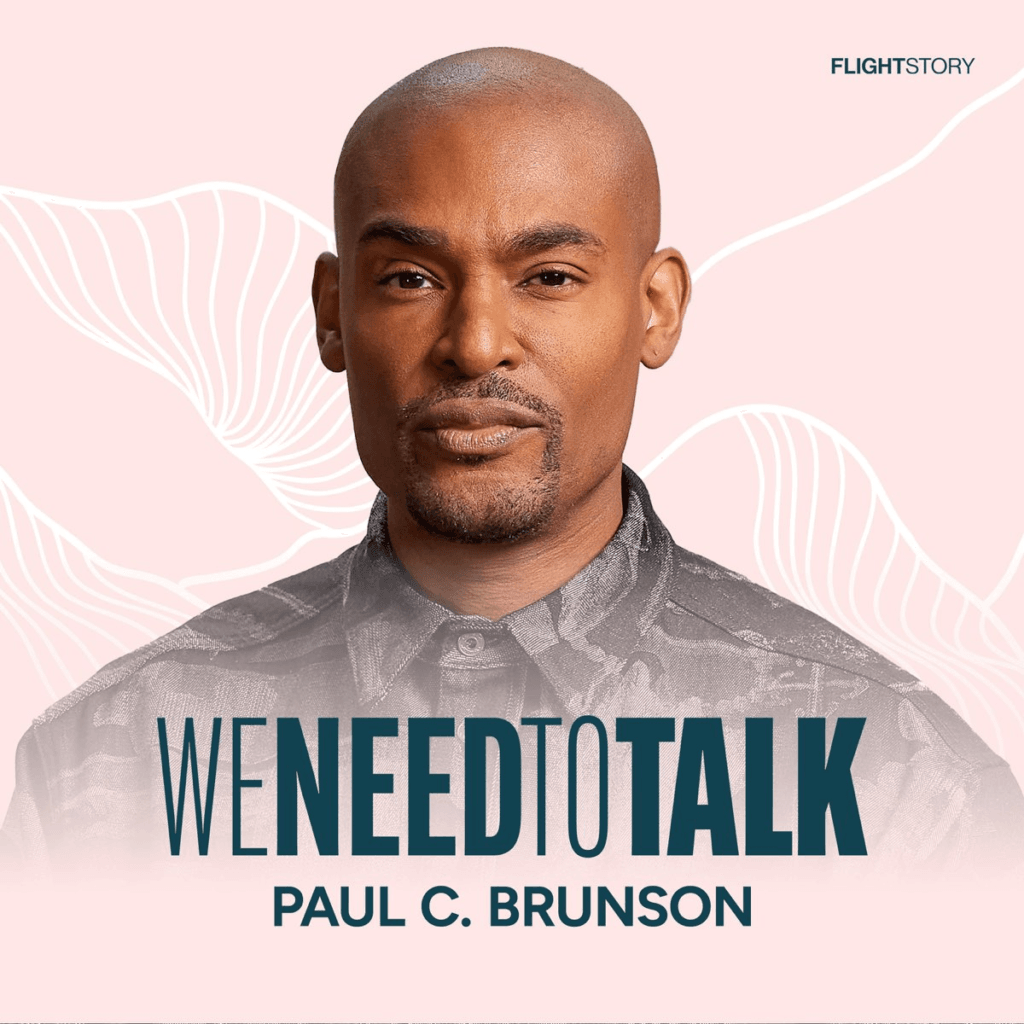
In shows like Paul C. Brunson’s We Need To Talk, pauses are not mistakes; they are intentional.
And this use of pauses helps to create depth to the conversation and allows emotion to surface. Without those pauses, the conversations would lose much of their impact.
Pauses as Punctuation
Pauses can also act as natural punctuation. They help structure your episode in a way that feels intuitive rather than forced. Instead of relying solely on music stings or verbal signposting, silence can do some of that work for you.
Not All Pauses are Equal
It is also worth remembering that not all pauses are equal.
A pause while you gather your thoughts is very different from a long silence caused by distraction or because you’ve got no idea what to say next. One adds authenticity, whilst the other may add confusion and is likely to loose the interest of a listener.
Leaving pauses in your episodes can also take pressure off you as a creator. When you know that every breath, hesitation, or moment of silence does not need to be edited out, recording can become less stressful and you are free to speak naturally rather than performing a perfectly polished version of yourself.
Related Post >> 22 of The Best Interview Questions to Ask Your Podcast Guests
Why You Might Want to Remove Pauses in Your Podcast Episodes
All of that said, there are absolutely times when removing pauses in your episodes makes sense. Not every silence adds value, and not every podcast benefits from a slower, more reflective pace.
Sometimes a pause is simply a result of distraction. You might be checking notes, losing your train of thought, or reacting to something happening around you. Pets making noise, someone walking past, or a sudden interruption can all create gaps that do not serve the listener.
In instructional or highly practical podcasts, too many pauses can become frustrating for your listener. If your audience is listening for clear, actionable information, extended silences can feel like obstacles rather than breathing space to reflect on what they’re being told. In these cases, trimming unnecessary pauses can help maintain clarity and momentum.
There is also the issue of consistency.
If your show has an established rhythm and style, sudden long pauses might feel out of place. Listeners build expectations around how a podcast sounds. If pauses disrupt that experience, they may pull people out of the content rather than drawing them in.
Editing tools that remove silence can be genuinely useful when used selectively.
If you have a pause because you are flipping through notes or restarting a sentence, cutting that out can tighten the episode without losing its natural feel.
The problem arises when these tools are used indiscriminately and you just cut every single pause for the sake of it, or because it’s easy to hit a button to allow a programme to remove all pauses and silences for you.
Another factor is accessibility.
Some listeners find long silences confusing or uncomfortable, particularly if they are unsure whether the audio has stopped working. In those cases, gentle editing can help keep the experience smooth and reassuring.
Ultimately, removing pauses should be about improving the listening experience, not following a rule. If a pause detracts from your message, distracts from your point, or breaks immersion, it probably does not need to stay.

The Impact of AI Editing Tools on How We Think About Silence
AI-powered editing tools have changed not just how we edit podcast episodes, but how we think about what a podcast should sound like. When software automatically flags pauses as something to remove, it sends a clear message that silence is somehow a flaw.
And this can subtly shift your mindset as a creator.
Instead of asking whether a pause adds meaning, you are encouraged to delete it by default. Over time, this can lead to podcasts that sound efficient but emotionally flat.
And we’ve all been there before.
I cringe listening back to some of my earlier podcast episodes where I sound as if I don’t breath for the entire episode because there isn’t a single pause for breath, let alone a pause for reflection or anything else.
The danger here is not the technology itself, but how uncritically it is used. These tools are designed to save time, not to make creative decisions for you.
When you let them dictate pacing and tone, you risk losing what makes your voice unique.
It is also worth considering who these tools are designed for. They work brilliantly for certain types of podcasts, particularly fast paced shows, solo commentary, or content driven by information delivery. They may be far less appropriate for narrative, interview, or reflective formats.
Giving yourself permission to ignore an AI suggestion is important.
Just because a tool can remove a pause does not mean it should. You are the one who understands your content, your audience, and your intention.
Related Post >> AI in Podcasting: Captivate Spark Full Review
Pauses As Part of Your Podcasting Style and Identity
Every podcaster and their podcast has a personality, whether intentional or not. And pacing plays a huge role in how that personality is created and comes across to an audience.
Some shows feel calm and spacious. Others feel energetic and fast. Neither approach is inherently better, but they are different.
Pauses in your episodes can become part of your style. They can signal that your podcast is thoughtful, conversational, or emotionally grounded. For some listeners, that is exactly what they are looking for.
This is especially true if your content deals with complex, sensitive, or personal topics.
Silence can show respect for the subject matter. It can acknowledge that what has just been said deserves space rather than being rushed past.
On the flip side, if your brand is built around quick tips, efficiency, or high energy delivery, fewer pauses may align better with your overall identity.
The key is coherence.
Your editing choices should support the experience you want to create.
It can be helpful to listen back to your episodes not as a creator, but as a listener. Notice how the pauses make you feel. Do they add weight, or do they feel like interruptions? Do they help you process, or do they pull you out of the moment?
Those reactions are valuable data.

Conclusion
The question of whether to leave pauses in your episodes does not have a universal answer. Pauses are neither inherently good nor inherently bad. They are a tool, and like any tool, their value depends on how and why they are used.
In a podcasting landscape that increasingly prioritises speed and automation, it is worth remembering that silence can be powerful.
Pauses can add depth, clarity, and humanity to your content. They can help listeners reflect, connect, and feel seen.
At the same time, not every pause deserves to stay. Editing is still an important part of respecting your audience’s time and attention.
The goal is not to keep all silence or remove all silence, but to make intentional choices.
Rather than asking whether you should cut pauses because a tool tells you to, ask whether those pauses serve your message and your listeners. If they do, you are allowed to keep them.
Your podcast does not need to sound like everyone else’s to be effective.
Sometimes, the quiet moments are where the real connection happens.

Verity Sangan
Hey! I'm Verity. I love all things podcasting and am passionate about helping more women to find their voice through podcasting. When I'm not working or busy with mum duties, I host Podcasting for Indie Podcasters (formerly The Lazy Girl's Guide to Podcasting).